Can U Read Fatiha for Non Muslims
| الْفَاتِحَة Al-Fātiḥah The Opening | |
|---|---|
| |
| Nomenclature | Meccan |
| Position | Juzʼ ane, Hizb i |
| No. of verses | 7 |
| No. of words | 25 or 29 |
| No. of letters | 113 or 139 |


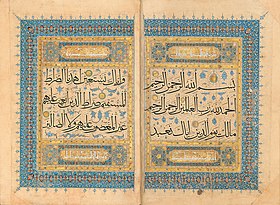
Al-Fatiha (alternatively transliterated Al-Fātiḥa or Al-Fātiḥah; Arabic: الفاتحة, IPA: [ʔal faːtiħah]; lit. "The Opening" or "The Opener"), is the first surah (affiliate) of the Quran. It consists of 7 ayah (verses) which are a prayer for guidance and mercy.[2] Al-Fatiha is recited in Muslim obligatory and voluntary prayers, known as salah.
Quranic chapter titles are non considered by Muslims to exist part of the divine revelation of the Quran.[3] The primary literal meaning of the expression "Al-Fatiha[4]" is "The Opener/The Key," which could refer to this Surah being the first in the Quran, the commencement affiliate recited in full in every rakat of salah, or to the fashion in which information technology serves equally an opening for many functions in everyday Islamic life. Some Muslims interpret it as a reference to an implied power of the Surah to open up a person to faith in God.
Summary [edit]
Surah Al-Fatiha is narrated in the Hadith to have been divided into two halves between Allah and His servant (the person reciting), the first three verses existence His one-half and final three beingness the servant's.[5] There is disagreement every bit to whether the Bismillah is the first verse of the surah, or fifty-fifty a verse in the get-go place.[half-dozen] The chapter begins by praising Allah with the phrase Alhamdulillah, and stating that it is Allah who has full authority over all creations (verse 1/2),[7] that He is Ar-Rahman Ar-Rahim or the Near Gracious and Most Merciful (poesy ii/three),[eight] and that He is and will be the truthful owner of everything and everyone on the Day of Judgement (poetry 3/4).[nine]
The last 3 verses, which comprise the servant's half, begin with the servant stating that they worship and seek only Allah'southward assist (verse four/five), asking Him to guide them to the Sirat al-Mustaqim (the Straight Path) of those who God has been bountiful to, and not of those who have earned His anger (verse 5-half-dozen/half-dozen-vii).[10]
Some Muslim commentators believe Jews and Christians are examples of those evoking God'southward anger and those who went astray, respectively.[11] [12] [13] [14] [15] [16] [17] [18] : 45 Others view this every bit an exclusive condemnation of all Jews and Christians from all times.[nineteen] [20] [21] The Noble Quran (Hilali–Khan), which is said to be the most widely disseminated Quran in most Islamic bookstores and Sunni mosques throughout the English-speaking earth, defines the two groups as Jews and Christians respectively.[22]
Other Muslim commentators have interpreted these verses as referring exclusively not to a specific group of people but instead translate these in the more than full general sense.[23] [24] [25] [26] [27] [28] [29]
Verses and significant [edit]
بِسْمِ ٱللَّهِ ٱلرَّحْمَٰنِ ٱلرَّحِيمِ ١
[Bismi 50-lāhi r-raḥmāni r-raḥīm(i)]
¹ In the proper name of Allah,[a] the Entirely Merciful, the Particularly Merciful.[b]
ٱلْحَمْدُ لِلَّٰهِ رَبِّ ٱلْعَالَمِينَ ٢
['alḥamdu lil-lāhi rab-bi l-'ālamīn(a)]
² [All] praise is [due] to Allah, Lord[c] of the worlds –
ٱلرَّحْمَٰنِ ٱلرَّحِيمِ ٣
['ar-raḥmāni r-raḥīm(i)]
³ The Entirely Merciful, the Particularly Merciful,
مَالِكِ [i] يَوْمِ ٱلدِّينِ ٤
[Māliki yawmi d-dīn(i)]
⁴ Sovereign of the Day of Recompense.[d]
إِيَّاكَ نَعْبُدُ وَإِيَّاكَ نَسْتَعِينُ ٥
['iy-yāka na'budu wa'iy-yāka nasta'īn(u)]
⁵ It is You we worship and You nosotros ask for help.
ٱهْدِنَا ٱلصِّرَاطَ ٱلْمُسْتَقِيمَ ٦
['ihdinā ṣ-ṣirāṭa l-mustaqīm(a)]
⁶ Guide us to the direct path –
صِرَاطَ الَّذِينَ أَنعَمتَ عَلَيهِمْ غَيرِ المَغضُوبِ عَلَيهِمْ وَلاَ الضَّالِّينَ ٧
[Ṣirāṭa 50-ladhīna 'an'amta 'alayhim, ghayri l-maghḍūbi 'alayhim wala ḍ-ḍāl-līn(a)]
⁷ The path of those upon whom You have bestowed favor, not of those who have earned [Your] anger or of those who are off-target.[thirty] [31]
Background [edit]
The most commonly accustomed view about the origins of the surah is the view of Ibn Abbas, among others, that Al-Fatiha is a Meccan surah, although some believe that it is either a Medinan surah or was revealed in both Mecca and Medina.[32] Most narrators recorded that al-Fātiḥah was the beginning complete Surah revealed to Muhammad.[two]
The proper name Al-Fatiha ("the Opener") could refer to the surah being the first in the Mus'hafs, the first to be recited in each rakat of salah, or to the fashion of its usage in many Islamic traditions as an opening prayer. The give-and-take itself comes from the root f-t-ḥ which means to open, explain, disclose, conquer, etc.[2] [33] Al-Fatiha is also known by several other names, such as Al-Hamd (The Praise), Equally-Salah (The Prayer), Umm al-Kitab (Mother of the Book), Umm al-Quran (Female parent of the Quran),[34] Sab'a min al-Mathani (Seven Repeated Ones, from Quran 15:87),[35] and Ash-Shifa' (The Cure).[36] [37]
Benefits and virtues [edit]
Muslims attribute special significance to some surahs for their virtues and benefits (fada'il, Standard arabic: فضائل) described in the hadith. Acceptance of the different hadith varies between Sunni and Shia Muslims and there is a variety of terms to allocate the different levels of confirmed authenticity of a hadith. Nonetheless, both Sunnis and Shia believe Al-Fatiha to be one of the greatest surahs in the Quran, and a cure for several diseases and poisons.[37]
Come across likewise [edit]
- Basmala
Notes [edit]
- ^ Allah is a proper proper noun belonging just to the one Almighty God, Creator and Sustainer of the heavens and the earth and all that is within them, the Eternal and Accented, to whom alone all worship is due.
- ^ Ar-Raḥmān and ar-Raḥeem are 2 names of Allah derived from the word "raḥmah" (mercy). In Arabic grammer both are intensive forms of "merciful" (i.eastward., extremely merciful). A complimentary and comprehensive meaning is intended past using both together. Raḥmān is used only to describe Allah, while raḥeem might be used to describe a person equally well. The Prophet (ﷺ) was described in the Qur'ān as raḥeem. Raḥmān is higher up the human being level (i.e., intensely merciful). Since i normally understands intensity to be something of short duration, Allah describes Himself too every bit raḥeem (i.e., continually merciful). Raḥmān too carries a wider pregnant - merciful to all cosmos. Justice is a office of this mercy. Raḥeem includes the concept of speciality - especially and specifically merciful to the believers. Forgiveness is a function of this mercy. In addition, Raḥmān is adjectival, referring to an aspect of Allah and is part of His essence. Raḥeem is verbal, indicating what He does: i.e., bestowing and implementing mercy.
- ^ When referring to Allah (subḥānahu wa taʿālā) , the Arabic term "rabb" (translated as "Lord") includes all of the following meanings: "owner, chief, ruler, controller, sustainer, provider, guardian and caretaker."
- ^ i.e., repayment and compensation for whatever was earned of proficient or evil during life on this earth.
- ^ Qira'at: All except for ʻAsem, Al-Kesa'i, Yaʻqub and Khalaf in i of his narrations read information technology as: مَلِك يَوْمِ ٱلدِّينِ ٤
Maliki yawmi d-dīn(i)
⁴ Rex of the Day of Recompense.
References [edit]
- ^ Qur'ans of the Mamluks, p. 193-194, 232.
- ^ a b c Maududi, Sayyid Abul Ala. Tafhim Al Quran. Archived from the original on 2013-07-28. Retrieved 2013-06-17 .
- ^ Nevin Reda Archived 2020-08-xiv at the Wayback Automobile, Introduction to the Quran in Three Testaments: Torah, Gospel and Quran (Plymouth: Rowman and Littlefield, 2012)
- ^ Sheikh, Irfan. "Ala Hazrat Fatiha Ka Tarika In Hindi Mein फातिहा का तरीका हिंदी". Irfani-Islam - इस्लाम की पूरी मालूमात हिन्दी . Retrieved 2022-02-16 .
- ^ Ibn al-Hajjaj, Abul Hussain Muslim (2007). Sahih Muslim - 7 Volumes. Vol. one. Darussalam. pp. 501–503. ISBN978-9960991900.
- ^ Mubarakpuri, Safiur Rahman (2000). Tafsir Ibn Kathir (10 Volumes; Abridged). Darussalam. p. 25. ISBN9781591440208.
[The scholars] disagree over whether [Bismillah] is a separate Ayah before every Surah, or if information technology is an Ayah, or a part of an Ayah, included in every Surah where the Bismillah appears in its beginning. [...] The opinion that Bismillah is an Ayah of every Surah, except [At-Tawbah], was attributed to (the Companions) Ibn 'Abbas, Ibn 'Umar, Ibn Az-Zubayr, Abu Hurayrah and 'Ali. This stance was also attributed to the Tabi'in 'Ata', Tawus, Sa'id bin Jubayr, Makhul and Az-Zuhri. This is also the view of 'Abdullah bin Al-Mubarak, Ash-Shaf i'i, Ahmad bin Hanbal, (in one study from him) Ishaq bin Rahwayh, and Abu 'Ubayd Al-Qasim bin Salam. On the other manus, Malik, Abu Hanifah and their followers said that Bismillah is not an Ayah in Al-Fatihah or whatsoever other Surah. Dawud said that it is a separate Ayah in the kickoff of every Surah, not role of the Surah itself, and this opinion was too attributed to Ahmad bin Hanbal. Malik, Abu Hanifah and their followers said that Bismillah is not an Ayah in Al-Fatihah or any other Surah. Dawud said that it is a divide Ayah in the beginning of every Surah, not part of the Surah itself, and this opinion was besides attributed to Ahmad bin Hanbal.
- ^ Mubarakpuri, Safiur Rahman (2000). Tafsir Ibn Kathir (x Volumes; Abridged). Darussalam. pp. 33–37. ISBN9781591440208.
- ^ Mubarakpuri, Safiur Rahman (2000). Tafsir Ibn Kathir (10 Volumes; Abridged). Darussalam. pp. thirty–33, 37. ISBN9781591440208.
- ^ Mubarakpuri, Safiur Rahman (2000). Tafsir Ibn Kathir (10 Volumes; Abridged). Darussalam. pp. 39–42. ISBN9781591440208.
- ^ Mubarakpuri, Safiur Rahman (2000). Tafsir Ibn Kathir (10 Volumes; Abridged). Darussalam. pp. 42–55. ISBN9781591440208.
- ^ Leaman, Oliver (2006). Leaman, Oliver (ed.). The Qur'an: an Encyclopedia. Routledge. p. 614. ISBN0-415-32639-7. Archived from the original on 2021-03-28. Retrieved 2020-11-05 .
The Prophet interpreted those who incurred God's wrath as the Jews and the misguided as the Christians.
- ^ Ayoub, Mahmoud M. (Jan 1984). The Qur'an and Its Interpreters: v.1: Vol 1. State Academy of New York Press. p. 49. ISBN978-0873957274. Archived from the original on 2021-03-28. Retrieved 2020-11-05 .
Most commentators have included the Jews among those who take "incurred" divine wrath and the Christians among those who accept "gone astray".(Tabari, I, pp. 185-195; Zamakhshari, I, p. 71)
- ^ Ibn Kathir. "The Quran Commentaries for one.seven Al Fatiha (The opening)". QuranX. Archived from the original on 29 May 2020. Retrieved 24 January 2020.
- ^ Al-Amin Ash-Shanqit, Muhammad (10 October 2012). "Tafsir of Chapter 001: Surah al-Fatihah (The Opening)". Sunnah Online. Archived from the original on 31 May 2019. Retrieved 24 January 2020.
- ^ Al Kindari, Fahad (vi June 2007). The greatest recitation of Surat al-Fatiha. Sweden Dawah Media Production (on behalf of High Quality & I-Media); LatinAutor - Warner Chappell. Archived from the original on 2021-11-17. Retrieved twenty Dec 2019.
The maxim of the Exalted, 'not the Path of those who have earned Your Anger, nor of those that went astray': the majority of the scholars of tafseer said that 'those who have earned Your Anger' are the Jews, and 'those that went astray' are the Christians, and in that location is the hadeeth of the Messenger of Allaah (SAW) reported from Adee bin Haatim (RA) concerning this. And the Jews and the Christians even though both of them are misguided and both of them accept Allaah's Acrimony on them - the Anger is specified to the Jews, fifty-fifty though the Christians share this with them because the Jews knew the truth and rejected it and deliberately came with falsehood, and so the Anger (of Allah being upon them) was the clarification most befitting them. And the Christians were ignorant, non knowing the truth, so misguidance was the description most befitting them. So with this the saying of Allaah, 'so they take drawn on themselves anger upon anger' (2:90) clarifies that the Jews are those that 'take earned your Anger'. And likewise His sayings, 'Say: shall I inform you of something worse than that, regarding the recompense from Allaah: those (Jews) who incurred the Expletive of Allaah and His Anger' (5:sixty)
- ^ "Surah Al-Fatihah, Chapter 1". al-islam.org. 23 January 2014. Archived from the original on viii December 2019. Retrieved 11 December 2019.
Some of the commentators believe that / dallin / 'those gone astray' refers to the misguided of the Christians; and / maqdubi 'alayhim / 'those inflicted with His Wrath' refers to the misguided of the Jews.
- ^ al-Jalalayn. "The Tasfirs". altafsir.com. Archived from the original on 4 September 2019. Retrieved 7 February 2020.
- ^ Abdul-Rahman, Muhammad Saed (2009). The meaning and explanation of the glorious Qur'an, second Edition, Volume 1. MSA Publication Express. ISBN978-1-86179-643-1.
- ^ Bostom, Andrew (29 May 2019). "Ramadan Koran lesson: Curse Jews and Christians 17-times daily: Role 1". Israel National News. Archived from the original on 30 November 2019. Retrieved nine December 2019.
- ^ Bostom, Andrew (29 May 2019). "Ramadan Koran lesson: Curse Jews and Christians 17-times daily: Part 2". Israel National News. Archived from the original on 9 Dec 2019. Retrieved nine December 2019.
- ^ Shrenzel, Israel (4 September 2019). "Verses and Reality: What the Koran Actually Says about Jews". Jerusalem Center for Public Affairs. Archived from the original on 9 Dec 2019. Retrieved viii December 2019.
- ^ Hilali-Khan (2020). "Estimation of the meanings of the Noble Quran - Surah ane". Rex Fahd Complex for the Printing of the Holy Quran.
- ^ Asad, Muhammad. The Bulletin of the Quran, Commentary on Surah Fatiha (PDF). pp. 23–24. Archived (PDF) from the original on 2019-11-26. Retrieved 2019-12-13 .
According to virtually all the commentators, God's "condemnation" (ghadab, lit., "wrath") is synonymous with the evil consequences which man brings upon himself past wilfully rejecting God's guidance and interim reverse to His injunctions. ... As regards the two categories of people following a wrong course, some of the greatest Islamic thinkers (e.g. Al-Ghazali or, in recent times, Muhammad 'Abduh) held the view that the people described as having incurred "God's condemnation" - that is, having deprived themselves of His grace - are those who take become fully cognizant of God'southward message and, having understood it, have rejected information technology; while by "those who get astray" are meant people whom the truth has either not reached at all, or to whom it has come in so garbled and corrupted a grade as to make it difficult for them to recognize it as the truth (see 'Abduh in Manar I, 68 ff.).
- ^ Ali, Abdullah Yusuf (2006). The Meaning of The Noble Qur'an, Commentary on al-Fatiha (PDF). p. 7. Archived from the original (PDF) on 2017-03-12.
...those who are in the darkness of Wrath and those who stray? The starting time are those who deliberately break God'southward law; the second those who stray out of abandon or negligence. Both are responsible for their own acts or omissions. In opposition to both are the people who are in the light of God's Grace: for His Grace not only protects them from active incorrect ... but also from straying into paths of temptation or carelessness. The negative gair should exist construed as applying non to the way, but as describing men protected from two dangers by God's Grace.
- ^ Shafi, Muhammad. Ma'ariful Qur'an. pp. 78–79. Archived from the original on 2020-07-18. Retrieved 2019-12-13 .
- ^ Tafsir al-Kabir, al-Razi, التفسير الكبير, Tafsir Surah al-Fatiha.
- ^ Al-Kashshaaf, Al-Zamakhshari, الكشاف, Commentary on surah al-Fatiha.
- ^ Maududi, Imam Sayyid Abul Ala. Tafhim Al Quran. Archived from the original on 2013-07-28. Retrieved 2013-06-17 .
- ^ "Corpus Coranicum: Commentary on the Quran. Chronologisch-literaturwissenschaftlicher Kommentar zum Koran, hg. von der Berlin-Brandenburgischen Akademie der Wissenschaften durch Angelika Neuwirth unter Mitarbeit von Ali Aghaei und Tolou Khademalsharieh, unter Heranziehung von Übersetzungen von Nicolai Sinai". 15 November 2021.
Das anaphorische ʾiyyāka (V. 6) betont die Exklusivität des Angerufenen, der anders als im Autumn der paganen mušrikūn, die Gott zwar in extremen Situationen um Hilfe rufen, ihm aber nicht dienen, vgl. Q 17:67, Adressat sowohl von Hilferufen als auch von Gottesdienst ist. An diese im Zentrum stehende Affirmation der Alleinverehrung Gottes schließt dice Bitte um Rechtleitung an (V. seven). Der hier erhoffte ‚gerade Weg' soll demjenigen der bereits von Gott mit Huld bedachten Vorläufern folgen. Sie werden nicht explizit gemacht und dürften zur Zeit der Entstehung der fātiḥa auch unbestimmt intendiert sein. Erst später – mit der Herausbildung von Kollektivbildern - ließen sich die Zielgruppen ex silentio erschließen
{{cite web}}: CS1 maint: url-status (link) - ^ "Surah Al-Fatihah - 1-7". quran.com . Retrieved 2021-09-12 .
- ^ Sahih International (Chapter ane; Verse 1-7)
- ^ Ahmad, Mirza Bahir Ud-Din (1988). The Quran with English Translation and Commentary. Islam International Publications Ltd. p. ane. ISBN1-85372-045-3.
- ^ Joseph E. B. Lumbard "Commentary on Sūrat al-Fātiḥah," The Report of the Quran. ed. Seyyed Hossein Nasr, Caner Dagli, Maria Dakake, Joseph Lumbard, Muhammad Rustom (San Francisco: Harper 1, 2015), p. 3.
- ^ "Hadith - The Volume of the First of the Prayer - Sunan an-Nasa'i - Sunnah.com - Sayings and Teachings of Prophet Muhammad (صلى الله عليه و سلم)". sunnah.com. Archived from the original on 2020-08-13. Retrieved 2020-11-xxx .
- ^ Abu al-Qasim al-Khoei. Al-Bayan Fi Tafsir al-Quran. p. 446.
- ^ Joseph East. B. Lumbard, "Introduction to Sūrat al-Fātiḥah," The Study Quran. ed. Seyyed Hossein Nasr, Caner Dagli, Maria Dakake, Joseph Lumbard, Muhammad Rustom (San Francisco: Harper One, 2015), p. 3.
- ^ a b Mubarakpuri, Safiur Rahman (2000). Tafsir Ibn Kathir (10 Volumes; Abridged). Darussalam. pp. 7–8. ISBN9781591440208.
Bibliography [edit]
- David James (1988). Qur'ans of the Mamluks. London: Alexandria Press. ISBN9780500973677.
External links [edit]
- Text of Surah al-Fatiha with multiple available translations
Source: https://en.wikipedia.org/wiki/Al-Fatiha
0 Response to "Can U Read Fatiha for Non Muslims"
Post a Comment